 +1 929 201 3767
 info@embroideredpatches.us
 Login
Login



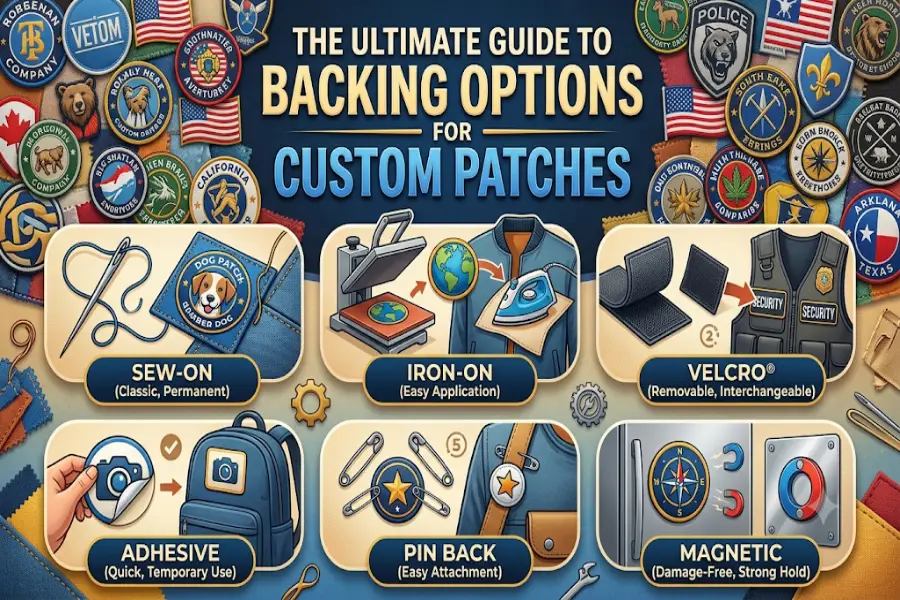
The Ultimate Guide to Backing Options for Custom Patches
Have you ever bought a beautiful patch for your favorite jacket, backpack, or uniform? Let’s be honest! It looks amazing at first. But just after a few washes or a busy day outside, it starts peeling away. Right?
However, you may not know this, but the quality of a patch isn’t only about its design. Then what is it actually about? Well, its backing plays a huge role not only in how well it stays attached but also in how long it lasts.
This is why you need to choose the right backing.
But the question is, how can you choose the best one if you know nothing about it? No worries! We’ll guide you. Let’s begin!
What Are Custom Patches?
Custom patches are basically decorative or functional pieces of fabric. These are designed not only with unique artwork and logos but also with text and symbols.
On top of that, these patches often represent a company, sports team, military unit, school club, or motorcycle group. Or they simply portray someone’s personal style.
But do you even know how these patches are attached to clothing, hats, bags, and many other fabric items? Well, they are actually attached using different backing methods.
Yes, it’s true that the front of the patch gets most of the attention. However, you must keep in mind that the backing is actually what keeps everything securely in place. And this is why backings are quite significant for these patches.
Many businesses and organizations choose custom-made embroidered patches. This is because they offer a classic and textured appearance. This basically helps the patches remain attractive even after years of use.
However, you must remember that the best backing depends on where the patch will be used, how often it will be removed, and how durable it needs to be.
What Are 6 Backing Options for Custom Patches?
Do you understand what custom patches are? Great! Let’s now take a look at the backing options.
The most common types of backing options for custom patches are iron on, sew on, hook and loop, plastic, peel and stick, and magnetic backing. However, choosing the best one depends on how long you want the patch to last and whether it needs to be removable.
1. Iron On
To begin with, iron on backing is actually one of the most popular choices. But why is that? Well, this is because it is quite easy to apply at home. Yes, it’s true.
You may not know this, but the back of these patches basically contains a heat-activated adhesive. When you heat it with an iron or heat press, the glue melts and bonds to the fabric. Yes, that’s it! Easy peasy, right?
This option is actually perfect for people who don’t know how to sew. Along with this, most cotton clothing, denim jackets, backpacks, and canvas bags work well with iron-on patches.
However, you need to keep in mind that not every fabric handles heat properly. But what fabrics won’t work for these patches? Well, materials such as nylon and leather, as well as waterproof fabrics, may not bond well or could even become damaged from high temperatures.
Are you searching for iron on patches in USA? If yes, then you can search for it online.
2. Sew On
Sew-on backing, on the flip side, is actually considered the strongest and most reliable option. Instead of relying on glue, the custom patch is stitched directly onto the fabric.
But why is it the strongest option? Actually, this is because it uses thread rather than adhesive. As a result, it stays attached even after frequent washing, heavy outdoor use, or demanding work environments.
Yes, sewing indeed requires more effort, but you must remember that it offers unmatched durability.
3. Peel and Stick
Peel-and-stick backing is also a great option. It actually works much like a sticker. You can simply remove the protective paper and press the patch onto a clean surface.
This option is basically designed for temporary use. And it works well for events, parties, trade shows, school activities, and promotional campaigns where custom patches only need to stay on briefly.
However, you must remember that you must not use it on clothing that will be washed regularly. This is actually because the adhesive eventually loses its grip.
4. Hook and Loop
Hook and loop backing allows custom patches to be removed and replaced whenever needed. It’s great, isn’t it? But how is it even replaceable? Well, it’s actually quite easy. Well, one side stays attached to the clothing, while the patch easily sticks to it.
This backing is actually quite popular not only among emergency responders and security teams but also among outdoor enthusiasts and military personnel. And this is actually because they often need to swap patches depending on the situation.
Did you know that you can also customize your military patch? Yes, you actually can with the help of hook and loop backing. This actually provides the flexibility to not only change names and ranks but also unit badges without replacing the entire uniform.
5. Magnetic Backing
Finally, and importantly, the use of magnetic backing provides a distinctive way to attach the patch. Indeed, you have guessed right. Instead of using either adhesive or sewing techniques, strong magnets are used to secure the custom patch.
This technique does not require anything to be sewn or glued to the fabric and hence keeps the clothes untouched.
Most Asked Questions Answered
Which patch backing lasts the longest?
Ans. Sew on backing generally lasts the longest. This is because it is stitched directly into the fabric instead of relying on adhesive.
Can iron on patches be washed?
Ans. Yes, iron patches can be washed. In fact, most iron on patches can handle regular washing, but repeated hot washes and dryers may weaken the adhesive over time.
Which backing is best for uniforms?
Ans. Sew on and hook and loop backings are the best for uniforms because they provide durability and flexibility.
All in All!
To choose the perfect custom patch, you must not only focus on its aesthetics. Yes, looks are important, but you must also consider the backing of your custom patches. Choosing the right backing is what ensures your custom patch stays exactly where you want it.
Iron-on backing offers convenience, and sew-on provides maximum durability. On the other hand, hook and loop backing is known for delivering flexibility.
Peel-and-stick is ideal for temporary use, and magnetic backing protects delicate fabrics while remaining reusable. However, before ordering your next patch, you must think about how often it will be worn, washed, or removed.

As a fashion analyst behind EmbroideredPatches.us, I love exploring the world of patches and all the creativity they bring. On this blog, I share tips, ideas, and simple techniques for making patches that last and look great. I explain colors, designs, and materials in a way that’s easy to follow, so anyone can try customizing their own patches. From small personal projects and gifts to collections and hobbies, patches are a fun way to add personality, style, and charm to clothes, bags, hats, and more. My goal is to inspire readers to bring their patch ideas to life, enjoy the process, and celebrate every little detail along the way.